Friday, November 4, 2011

Empress Zoon

Born into a poor peasant family in 16th century Kashmir the mystic poetess, empress
of Kashmir "Habba Khatoon" needs no introduction. Married early at the age of 16,
Habba Khatoon or Zoon was left withered atrophy at her in-laws. A cruel mother-in-law and an indifferent husband could never harmonize with her feelings. But Habba Khatoon's bosom was filled with love and promptly as in a fairy tale happens the royal emperor Yusuf Shah Chak who was once contemplating by the stream heard her heart wrenching pathos. Their eyes met. It's those split of seconds when you empty your heart of plan, ambition: when you give yourself completely to the golden fate filled moment: and The emperor fell for the damsel.

Below is her heart wrenching pathos- Maliev Nev ho. A wife's agony, a daughter-in-laws prick.
http://dl.dropbox.com/u/47808573/Kashmiri%20song%20by%20%20Habba%20Khatoon%20%28%20Malie%20Nev%20Ho%20%29.mp3


                                                              Origin Of Gulmarg


Riding on his royal steed on one tardy June afternoon, Yusuf Shah Chak tromped upon a beautiful meadow; with its flowers as bright as lustrous smile and grass marooned strands littered vast, the emperor of great romance and refined taste was left bewildered; he named it Gulmarg- The meadow of flowers!

Friday, October 21, 2011

The Man Who Would Be King- 1975


Truly, truly brilliant. It is so rare that I see a film that I wouldn't change, and I honestly can't think of a thing. Huston's films so often include that quintessential scene -- the one where his characters realize that they've lost everything, and respond with unbridled true character. Those who cry or bemoan the loss are beyond redemption. But those who can laugh in the face of disaster, who can ask forgiveness for the patently unforgivable -- they are the greatest of Huston's figures, and perhaps the greatest characters of cinema. Just as Bogart and Hepburn laugh while they lie in the bottom of a boat awaiting death, Michael Caine and Sean Connery face certain death in this film and respond with complete honesty and complete honor. For all of their lies and arrogant ambitions, they are still a pair of b*****ds you would love to know.

Which brings me to the two incredible performances. It is nearly impossible for such recognizable actors to fade into the guise of their characters. But Caine and Connery manage it, and with perfect aplomb. As best friends, they are perfectly inseparable, and their innate connection makes for one of the most affecting male friendships in history. Surrounded, with no reasonable hope in the world, Danny asks Peachy to forgive him for being "so bleeding high and so bloody mighty." And, of course, Peachy forgives him. These are men who sing boldly in the last moments of life. God bless John Huston.

Wednesday, October 19, 2011

Must be Autumn In Kashmir

Its autumn in Kashmir-
The season when heat of summer is buried under
the blanket of crisp leaves.
The red- russet chinar leaves must be scurrying down
the garbled junctions before the wind.
Criss crossed lanes must be wafting with
roasted chestnuts and children with running noses.
Smokey evening dusks must be hovering over
the purple hills; that pickle peddler must be calling too.
- Aanchaar maa ho!
The rich green pallete of summer must be turning into
mottled autumn hues of reds, oranges, golds, and brown
before leaves fall off the trees.The half reaped furrows
of John Keats "To Autumn" must be silently oodling some sleep.
The afternoon siesta under a meek sun!
Naked tulip and Poplar trees must be swaying its own
autumn wardrobe even as smug conifers stands "Evergreen".
 The celery must be out too, drying up on the walls by a loop.
It must be Autumn in Kashmir!

Saturday, October 15, 2011

Habba Khatoon


Habba Khatoon the greatest kashmiri poetess of the sixteenth century, has been a source of many imaginative narratives, poems, plays, films, discursive essays and television serials. It is her charismatic personality and at the same time our historians’ inexcusable negligence that Habba Khatoon has been left as subject for un-academic and speculative debate as if she were a character of folk myth. As a corollary, Habba Khatoon is still shrouded in a multi-layered, almost impenetrable, shroud and a part of collective myth. The only authentic thing about her is a body of poetry (recently anthologized by Mr. Amin Kamil), that remains unparalleled to date not only for its lyrical sublimity but also for its popularity. No other poet in the Kashmiri language can excel her in representing common man’s longings, yearnings, nostalgia and romantic fervor in verse. The intensity of sentiments, brilliant imagery and ecstatic mellifluous rhythm make her lyrics universal in appeal, comparable to the greatest poetry in any other language. Our historians, chroniclers, literary critics, and professionals have exhibited an unpardonable nonchalance toward Habba Khatoon who choose to write in the vernacular. It was about two hundred years after her death that Abdul Wahab Shaiq (1765) for the first time mentioned her name (Habibah) in his history in Persian verse. He, however did not give any remarkable details about her life. It seems that Habba Khatoon’s life sank into oblivion soon after the fall of the Kashmiri Sultans. Other historians used their reckless conjecture in molding the story of a historical personality in such a way as suited their purpose. In recent years, an absurd, tough astounding, addition to the irresponsible conjectures has been made by Mr. Anis Kazmi whose oral statement was recorded by Dr Bashar Bashir. Mr Kazmi with reference to a chronicle entitled Gulistani Shahi (source unknown), says that Habba Khatoon hailed from the genteel of her time as her father was one Syed Baha-ud-Din and her mother was one Bibi Badi-Ul-Jamalata (Srinagar). A verse ascribed to Habba Khatoon has been quoted to support this new tale. We have always to bear in mind that the singers of various times have made several interpolation in the popular lyrics of Habba Khatton. In 1951, Late Jagannath Wali wrote a play, entitled Zoon, on the life of Habba Khatoon. Besides changing the events to his convenience, he composed a few songs and ascribed them to Haba Khatoon, the famous song in the form of a dialogue between Yousuf Shah Chak and Habba Khatoon is Wali’s own composition. Yousuf Swandrah che dramits chalith ti chukith rud maa wale lolioaay Zoon aiy paadshaom dul thaami thaav saafiy, taaphyiy karey lolioaay Of late, Amin Kamil’s Kulyati Habba Khatoon, an admirable attempt indeed to collect every lyric and tale ascribed to Habba Khatoon, too, does not reveal any thing authentic about the life of the epoch-making poetess. Similarly, Ghulam Rasool Bhat’s book, Habba Khatoon : Tarikh Ke Aine Main, adds only to the amorphous, contradictory and confusing statements. It is deplorable that TV film Habba Khatoon and Shafi Shauq’s script of 13 – episodes TV serial Habba Khatoon have also mislead the public by presenting figments of their own making. Since the process of distortion has reached it critical point, time has come for a serious reconsideration so that the bits of history are re-arrayed to reconstruct the profile of Habba Khatoon and the future generations are no more mislead by the tradesmen in learning. The most cogent historical narrative of Habba Khatoon emerges from a long poem in the form of a mathnavi composed by Ghulam Mohammad Hanafi (1867-1927) of Sopore. Hanafi has drawn upon a legend very popular in Kamraz and Gurez. The outline of the story is that Zoon or Habba Khatoon was a lovely daughter of Raja of Gurez. He was inundated by debts and owed also huge money of Hayaband, a trader of Lalahome village of Kamraz Being unable to repay him, the Raja gave his loving daughter in marriage to Hayaband’s son, names Aziz Lone. (A sizable population of Gurez is still of the Lone caste).
She was ill-treated by her in-laws and she gave vent to her suffering in many a poignant lyric. Meanwhile the king of the time Sultan Yousuf Shah Chak, who also belonged to Dardistan, saw her and was eventually captivated by her beauty and melody. He listened to the tale of her suffering and decided to marry her. Yousuf Shah Chak got her divorced from her husband, married her and took her way to his court. Yousuf Shah Chak, at that time, was already father of a grown up son, Yaqub Shah Chak. Although romantic in nature and given to pleasure – mongering. Yousuf shah could not enjoy peace as he was constantly at strife with the mughals who were adamant to annex Kashmir. He ws greatly consoled by Habba Khatoon who, besides being a poet, possessed prowess in music. The king was arrested by Akbar and then sent on forced exile to Biswak Bihar. Habba Khatoon languished in separation from Sultan and composed several heart – wrenching lyrics which she sang while wandering from village to village.It was Abdi Rather of Tsandhaar (Pampore) who gave shelter to the lovelorn Queen Poet. The narrative is almost entirely different from the story popularized by those writers who, without any documentation and research, wrote about her for various considerations.
The above life sketch of Habba Khatoon was supported by one of the most profound researcher of the late twentieth century, Prof. Mohi-us-din Hajani who recorded the narrative of Mala Habib Hajan. In his extremely valuable collections of essays in folk lore, luki ras, Prof. Hajani has not only refuted the officials version of Habba Khatoon’s life but also produced some thought provoking evidences in favour of the version widely popular among the folks of north Kashmir. The present excursus is an attempt to highlight some more irrefutable evidence to prove that the great romantic poetess hailed from Gurez and not from Pampore. Dardistan, being the watershed where the Central Asian languages and culture came into contact with the Indo-Aryan languages and culture, retains many archaic linguistic expressions that cannot be ignored while searching for the genealogical kinship of the Kashmiri language. A glossary of such archaic words, now obsolete in Kashmiri proper spoken in the Valley, is urgently required. Similarly, many places of north Kashmir have retained names that besides being antique, speak volumes for being intimately related to myths, legends and history of Kashmir. Some of the names are profoundly symbolic in nature, for example, Harmwakh, Krishan Ganga, Kanzalwan, Tistarnar, Madhumati, Arin, Burzibaal, sharda, Pushkar etc. All these places reflect the fact that the mountains terrain of the north-west of Kashmir was dear to the sages and hermits of the past as its suited them for spiritual meditation.

Courtesy: Various sources

Saturday, October 8, 2011

Koshur Wazwaan- Poetry of taste buds

The eerie silence of a quiet September morning was broken. Waza the time-honored
Kashmiri cooks had arrived. It was my cousins marriage. Maaenz raat- the day when all the preparations for impending three days of gastronimical feast is set up. Amazed on seeing the man management of the group the head Waza (Vouste) without ever laying any orders got things started with supinate ease. Wood was re-cut as the first thing, logs were too large as he started taking stock of the things around. Wazwaan is cooked in traditional spices and the waza's are very particular to have them right. Else they can get really fussy over it. It is said in folklores of every Kashmiri household that "waaerr zaliin" is the toughest part. Not for its combustibility but for the preparation. Once the process starts it's a cakewalk from then on for both: the hosts and the waza's.

Meanwhile, the soon to be gluttony arrived. In hooves the sheep were one after the other bought down. Later large chunks of mutton were shifted to the waza's waerr where with utmost precision the pieces were relaid. You could say that even with clog eyes the waza would know where to hit his sharp ground butchers knife on the mutton dollops. It was a sight to behold. Lunch on a maennz raat is served with what is called as "Chervann Batte", remarkably tasty and fresh. Chervann Batte is a mixture of leftover kidneys and liver with some fresh vegetables like Spinach cooked deliciously over red spices. Chervann Batte is loved by all and is a personal look forward regale for me on weddings.

By afternoon the waza's were well on their way. An experienced household member is attached to the waza's. He acts as a mediator between waza's and the host (read Yaezz mann). It is he who decides when the lunch or dinner is to be served with the waza taken into confidence. And of course in addition to jollifying on the Wazwaan every now and then. "Talsa ath Rogan josh'as hav te nonne keoth chus." "Tabak Maaz chu venni thoda turunn", are very frequent lines used.

Evening was hot footing with the waza's pouncing on the mutton with their wooden wedges producing a thumping voice of musical ballad. Round mutton balls mixed with enormous creamy fat were laid all over. The would be: Rista's and Goshtabas. Though there is no count of the dishes that can be served in a wazwaan but usually Seven traditional dishes are a must. Rogan josh is tender lamb cooked over thin red gravy with butter oozing. Tabak Maaz is Lamb ribs fried and served as an appetizer. Daniwal Korma consists of thick rich mutton gravy cooked with fresh coriander while as Rista and Goshtaba are small and large round mutton balls. Goshtaba is simmered over yoghurt.

Friday, July 8, 2011

Aru- Travelogue


It was around 2 in the afternoon when Hussain, our bemusing sturdy little shawl weaver friend from Pahalgam, dropped us in his rickety Maruti Zen at Aru- a pretty village set amidst tall Himalayan mountains, boundaring Lidderwatt valley on one side and Aram Pathri on the other. It had been 4 years since I was last here; not that much had changed here, except, perhaps for odd tourist's- one's riding those cross-breeded, malnutrishined horses (or Mules I should say). The horsemen on their own treated callow and credulous tourists with their self made tales to attract awe. I overheard one horseman pointing to the JK Tourism cafĂ©- proudly declaring it the Mansion that Amrita Singh owned in Betaab movie. Betaab was shot some 20 kms away from Aru.

We yearned for a cup of tea to plan our trip on. Last time when I was here I had befriended a very noble man named: Ashraf. Ashraf had a modest motel back then but his cooking skills were far from modest. I looked around for him. Unfortunately, the motel was rented to some other guy it seemed this year. Just as when we finished our tea, Ashraf walked in to my wanting surprise. He looked pale and had lost weight. I greeted him, to which he responded.  He recalled that we had parked our car in this motel's backyard and how we relished his late candle-lit dinner in rain drenched clothes. Four years back the high alpine torrential rains had followed us all over from Aru to Kolohai Glacier.  For this year Ashraf had taken a provision store near the other alley of the village. He told me he was not well and had some neurotic disorder, for which he was treated in Shehar (Srinagar).

Ashraf was actually from Sallar- a beautiful village on the road between Bijbehara and Pahalgam. Meanwhile we were introduced to Ali Bab- a 50 something year old man, who owned two horses and ferried tourists around Aru on them. He was tall, strong and had a slight bent back. He resembled Clint Eastwood. Ali Bab agreed to help us and offered one of his accomplices as our guide for our next days trek to Aram Pathri, as we layed our map on the dark brown table, sipping lipton chai. Mohsin, Ali Bab, Javed (the motel owner), Ashraf and I drawing our essential items required for the trip. Ali Bab knew we wanted him to be our guide and agreed. As we came to know later, Ali Bab's true love lied in mountains. People respected him a lot, fondly calling him the ‘Akash’ of these mountains. He offered us to stay with him at his house for the night and leave tomorrow early morning for Aram Pathri. We buoyantly agreed. We preferred to stay close to village life for a day. Eat in their utensils, share their joy and assemble some memories.

As we passed through the narrow alleys of Aru Village, life seemed sullen and dull- a quiet oasis. No one seemed to be in any haste. An old couple was sitting on the porch puffing hukka by turns; colorful dorking roosters with flowing earlobes were crowning almost from every house- houses that had thatched rooftops and brown sludged barns; aspen like Poplar trees were swirling with the wind carried from the surrounding mountains; pretty village girls lined up near the narrow stream, which flowed right through this hamlet, were washing clothes: smiling and giggling within as we passed through them, whispering jokes in sneaky tones. Perhaps, they were amused to see two city dwellers walking into a village; a village which visibly had had not hosted a visitor from a longtime.

Ali Bab's house was a typical village log-hut- warm with lots of wood work and clay quoting. In the hallway lied a stack of rice bags and whole gram. Good indication that the family was doing well. After all, Ali Bab had been tending foreign tourists over the years. As he said later that afternoon while sipping noon chai in his koshur pyale, that his life was different before '90. 

We took to the guest room, which was on the first floor, through a wooden stair-way that amplicated the noise of footsteps. The wooden stair-way reminded me off my childhood days at my ancestral house in Khanyar. The sound produced by the footsteps were distinct, for our each family member. Father's were delicate but brisk. Grandfather's were the first I used to hear early in the morning. His resembled as if someone was playing drum beats with great musical taste. The room was large with beige clay quoting on walls and tiny shapeless mirrors engraved at some places. Windows from two opposite far ends ventilated the room perfectly. Calendars from yesteryears officiated as decorative hangings.

-       Tantray Brothers- A house of hosiery goods, declared one.

By now it was evening, calm and meloncholic. Smokey chimneys left grey incense clouds in the air, which in the evening hue looked like fairies dancing, as I gaped through the window. The village looked straight from those story books, read years ago at school. Ali Bab came back from the days work and tied his two horses in the barn.

Dinner was ready and we were called out to join. Kitchen was neat and shiny. Copper appliances adorned the shelves right across the entire lengths of its walls. The radio played Kashmiri songs in the voice of Waheed Jeelani. Ali Bab's wife Hasina was puffing hooka and daughter Zahida was busy giving final touches to the chicken which Ali bab had brought from the nearby shop. Soon a mid aged man entered and introduced himself.

 -    'I'm Mushtaq Ahmed Shah'

stressing outwardly on Shah. As Shawl later told me , Shah is a revered and elite cast in villages. Mushtaq worked in the forest dept. and was posted at Aru. He was Hasina's distant relative, who meanwhile still was concentrating on her hukka. Hasina on her part had grown old. Wrinkles on her face spoke a nonchant tale about her hard life. She had deep green graceful eyes, the ones which generate warmth and acceptance easily. Years of carrying brooks as firewood from the forest could be seen written all over her . And she was visibly irritated at her husband's penchant for mountains. I think the idea of being left all alone, all by themselves ,was the reason for such churlishness. The couple had 3 daughters- two were married. Walls in the living room adorned pictures of those two son-in-laws. Zahida was youngest and still unmarried. She had a distinct village girl look. Fair, young and exceedingly orange. In fact she was orange right from her crochet sweater to her plump cheeks. While waiting for the dinner I couldn't help but think about the scene where Ali Bab's daughters marriage must have been ceremonised. Guests must have poured from near and far. The open patch of land near the barn must have been decorated with red and yellow draperies for Grooms welcome. Women must have danced rouf and sang songs of folkfare. Biding adeiu to his daughters must have been painful for Ali Bab and Hasina. The tough man must have wiped tears flowing over his stubble beard.


At the same moment my thoughts travelled to the scene where Ali Bab's father or mother must have died. It must have been a tough wintry day. Everything must have been covered in thick white snow. The local cleric must have offered jinaza in the courtyard. Winters are tough for old to survive. Thinking about the years that must have gone by in this household made me pleasingly connected to this family. We ate our dinner together and left to sleep. Next day we had to start early.

We were heading for the mountains of Aram Pathri, a trek that would take us into a wilderness of peaks, inhabited by nomads who wound their way through untrammelled landscape. Aram Pathri is a valley that lies straight above the cliff when looked from the Aru village verge. We started off early in the morning walking through the village first, where people greeted Ali Bab all along; then through the passage above the stream which carries waters from Katarnag and various other glaciers. The noise formed by the gushing waters hitting rocks early in the morning with pleasant air and absolute pristine clear blue skies gave enough of what was more to be expected. The aroma of cedar and pine was growing and Aru village seemed distance away, unseen now as we walked amidst tall pine trees. Our first brush with human habitation was at Gagan Gir- a tiny shepherd hamlet, which acted as the first halt for these yearly visitors. We decided to have tea in a shepherd hut called Dhoke. 

The dhoke, was constructed of four sturdy trunks around which stone walls had been built, using mud as mortar. Someone had pushed little strands of wild plants into the cracks, allowing them to cascade down the walls. The family sat mute, smiling. 

We entered the dhoke and made ourselves comfortable on the hay. Soon the hut was engulfed by children, who came to see the uninvited visitors. We clicked their pictures and a genuine smile was passed in return. Not bad for a bargain. The elder shepherd men sported Babylion beards and could be easily mistaken as old testament prophets. Turbans were usually green and maroon colored. Shalwars and loose duffel shirts were topped by brocade jackets which seemed to have endless pockets. Women wore robes of beautiful color with beaded hair and shawls draped over. Jewellery was minimum but enough to grab an eye. Copper earnings and nose beads on those charming shy faces looked absolute pristine. 

We pushed along a herder's path through creaking pines till we criss-crossed across ancient boulders, formed by thousands of years of sedimentation. Green pastures awaited us after few difficult jumps on the boulders were safely negotiated. The smell of lilac filled the air. The skies were clear, meadow bereaved even of grazing sheep- we were clearly a few weeks too early into these pastures. The wildflowers were only just coming out on the hillsides, springing up with extra vigor because of the snowmelt. Little streams wound between pollarded willows, their crystal-clear water flowing between banks of vivid green moss. We took small breathers, in between, inhaling the fresh spring air of high Himalayan alpine pastures. 

We camped at a place called as lower Aram Pathri- as the snow ahead us didn't allow us to pitch our tent any where else. We had a empty shepherd's hut close-by, where Ali Bab tied his ponies and prepared hot sipping tea on the earthen fire pot, which would be used by its owners in a few weeks time.  A small stream wafted along the ridges, where we had spotted a brown bear. A few annoying whistles by Ali Bab seemed to undeter him.

With enough time on hand, we spent the remaining late afternoon lazing around, reading books, giving rest to our tired legs, laying feet in extremely ice-cold water of the stream- firm in our belief that these pastures and meadows must have hosted many a sufis and yogis in olden times. The landscape could invoke spiritual highness, Shawl and I contemplated, as darkness deepened, with sun going down above the cragged peaks.

We spoke about many things seated near our campsite- sufism, spirituality, meditation, Kashmir. We go back  a long way, me and Shawl. A friendship that fostered on mutual admiration and liking- we have too many things in common: which made us to call each others soul-mates. Its a wonderful feeling to have deep inside our heart, that there is a friend whom you can call anytime, for anything. Its always hard to define but there are feelings that go with it.

Our conversation kept on drifting, invoking deep and profound reverie on the spiritual up-liftment of the soul. Of how the wiseness lies in letting go off things, at times. 'Everything that we desire, may not necessarily belong to us,' said Shawl, while dragging another puff from his classic cigarette. I had recently laid my hands on a Zen book, that dwelled on- the purpose of life. We argued over desire- which suffocates our soul inside. Desire has no end, we both seemed to agree. The meteorite streaked skies above us, and Ali Bab's uninterrupted lipton chai, kept our conversation going. Suddenly, the absolute wilderness around us insinuated our expressiveness- the lack of which we all suffer from. 'We have to embrace the wisdom of humanity, the meaning of life is to serve the force that sent us into this world. Then life becomes a joy,' Shawl quoted Tolstoy. Let doubts dilate in us about our own existence, I quietly whispered to myself while Ali Bab refilled our cups. Small doubts, small enlightenment. Great doubt, great enlightenment, I remembered a Zen saying from the book that I'd been reading.
On way to Aru-Pahalgam

Aru-


The cliff above the village- in the chasm at the right corner of the picture is the lake of Katarnag


Aru Hamlet


Grazing sheep- deft art of whistle, shepherd boy.


Walking towards Ali Babs house in village Aru.


The hookah puffing old couple.


Ali Bab's wife- Haseena


Ali Bab's quaint abode. Barn in the foreground.


Kitchen- neat.


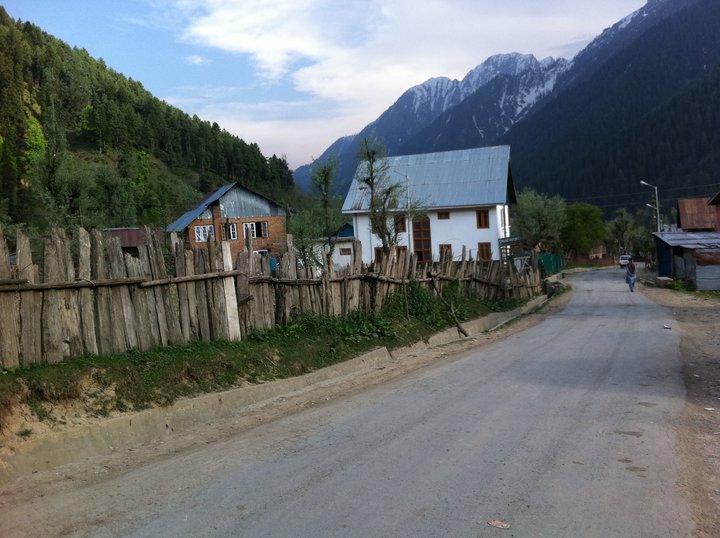
An evening walk.


Next morning. Starting from Aru.


Shepherd hut at GaganGir.


A quiet lurch-somewhre in the green pastures

Thursday, July 7, 2011

Anurag Kashyap's Gulaal (2009).

Gulaal is an archetypal movie. As per Anurag Kashyap's own confession, Gulaal is a movie very close to his heart, and it is not difficult to see why. Made with deft art, intricate cinematography, crisp editing and wonderful analogues, which contrastingly give an idea of what the director wants to portray, Gulaal's pace keeps you gripped. Like the way funny character of Bana is played by Piyush Mishra. An eccentric poet who worships John Lennon and keeps questioning the society for its hollow laws and subjugation of the meek. It is this magnificent knack that the director has which makes you believe in the renditions of this eccentric poet. You can't help but love Piyush Mishra.


The movie starts with a dedication note to the pre-freedom poets who had this vision of free India which somehow was lost without ever its realization. Moving all along superbly giving a
true insight of ghastly students politics and nepotism.A young woman played by the hot Jesse Randhawa is sexually abused and left all alone. No order of any sorts. No one seeks justice.
It's a Godforsaken term in post-independent India. Gullible law student played by Raj Singh Chaudhary is slicked by dirty political mud. 'Ransa' played by Abhimanyu Singh as the blue blooded
Rajput brat, who detests aristocracy and his fathers lineage. You have posters of democracy and capitalism all over Ransa's home: in a satirical fashion mocked. Whiskey and wines are named
after democracy, capitalism and constitution.

And Kay Kay Menon as Duki Bana the lead actor is just impeccable. No praise is enough for his acting. Angry with the system which took all his privileges he is bent upon bringing a revolution by crook and not by hook. Just what perhaps modern India is all about.

Don't miss this if you are a Anurag Kashyap cinema man.